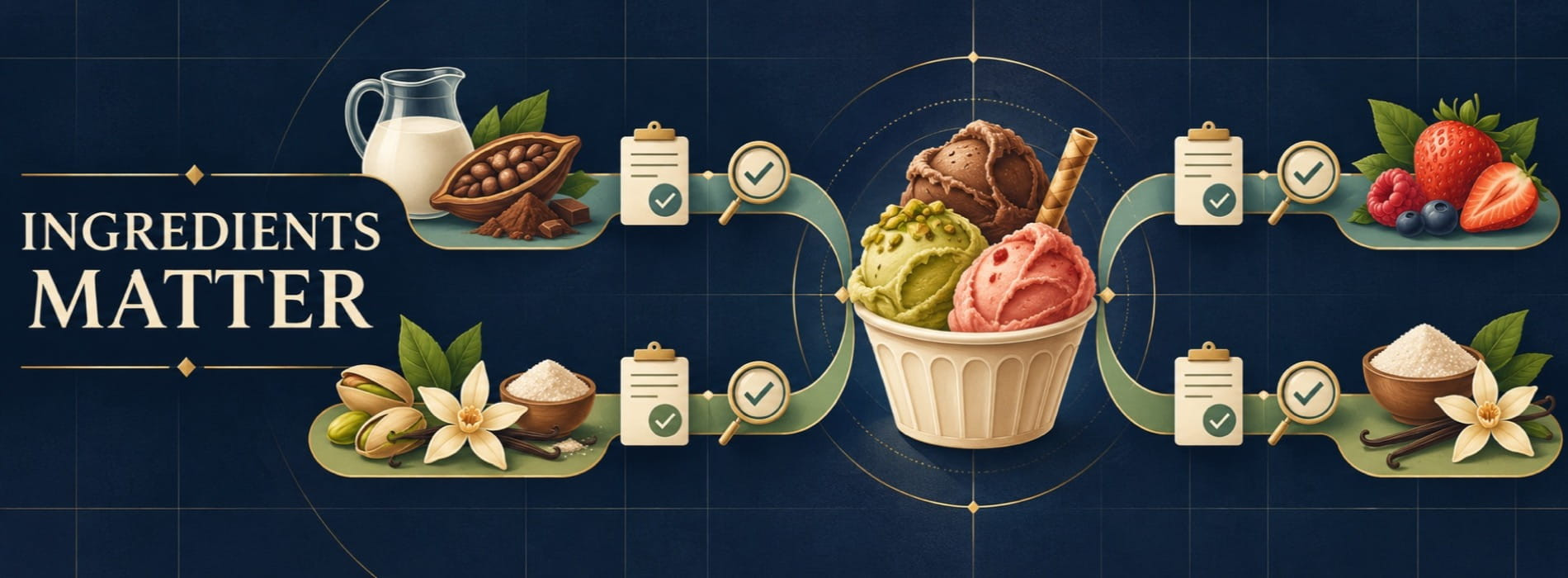
Halal and Kosher are religious certifications: they guarantee that a food complies with Islamic (Halal) or Jewish (Kosher) dietary laws. They matter to a gelato shop for two reasons: they let you serve customers who follow these rules, and they are a sign of ingredient control that other customers appreciate too. In gelato the critical points are few but specific: alcohol, gelatine and animal fats, dairy, and equipment.
At a glance
- Halal means "permitted" under Islamic law. Pork and its derivatives, alcohol, blood and meat from animals not ritually slaughtered are forbidden.
- Kosher means compliant with Jewish dietary laws. A rabbinical agency checks ingredients, plant and production; meat and dairy are never mixed.
- A certified ingredient does not make the gelato certified: the certification covers the manufacturer's product, not the gelato made in your lab.
- Gelq.it stocks 658 Halal-certified and 582 Kosher-certified products from eight producers: Rubicone, PreGel, Martini, Fabbri, MEC3, Pernigotti and Luxardo.
What does Halal mean?
"Halal" is Arabic for permitted, lawful. Its opposite is haram, forbidden. For food, the main prohibitions are:
- pork and its derivatives;
- blood and animals not slaughtered according to the rite;
- alcoholic drinks and foods containing alcohol as an ingredient.
There is also a grey area, doubtful ingredients (mashbooh), whose origin must be checked: gelatines, animal fats, enzymes, some flavourings and emulsifiers. In a gelato shop the points to check are flavourings in alcohol, pastes with liqueurs (rum, marsala, amaretto) and any stabilisers of animal origin.
What does Kosher mean?
"Kosher" describes food that complies with Jewish dietary laws (kashrut). Certification is issued by a rabbinical agency that checks the ingredients, the plant and the production. Three rules matter for gelato:
- Every ingredient must be kosher, including flavourings and additives.
- Meat and dairy are never mixed. Foods are classed as meat, dairy or pareve (neutral). Milk-based gelato is a dairy product.
- Equipment matters too: equipment used for non-kosher products may need a ritual cleaning procedure.
On packaging, certification is shown by the certifier's symbol. For example, for the US agency OU the OU-D symbol marks a product that contains dairy or is made on dairy lines.
Are Halal and Kosher the same thing?
No. They share some points, such as the ban on pork and attention to the origin of ingredients, but they follow different rules and are issued by different bodies. A product can be Halal-certified but not Kosher, or vice versa: that is why every product sheet must be checked.
Who issues the certifications in Italy?
| Certification | Bodies (examples) |
|---|
| Halal |
Halal Italia, the brand of CO.RE.IS. (Italian Islamic Religious Community), which certifies according to the technical standard of its own Ethics Committee; other bodies also operate in Italy, such as Halal International Authority |
| Kosher |
K.it, the agency of the Union of Italian Jewish Communities (UCEI), supervised by the Italian Rabbinical Assembly; Kosher Italia; international agencies such as OU (Orthodox Union) and KLBD (London Beth Din) |
Gelato ingredient manufacturers are certified by one of these bodies. The certifier's name appears on the certificate and often on the technical data sheet.
If I use certified ingredients, is my gelato Halal or Kosher?
Not automatically. The certification covers the manufacturer's product. The gelato you make in your lab becomes "certified" only if the gelato shop itself is certified by a body that checks all ingredients, equipment and processes.
What you can do without being certified:
- Use only certified ingredients for the flavours you want to offer these customers, including pastes, ripple sauces and toppings.
- Avoid alcohol and doubtful ingredients in those flavours.
- Keep spatulas, tubs and equipment separate.
- Keep the manufacturers' certificates or technical sheets to show to anyone who asks.
- Communicate correctly: "made with Halal-certified ingredients" describes the ingredients; "Halal gelato" or "Kosher gelato" should be used only if the shop is certified. Ask the certifying body for details.
Which certified products can you find on Gelq.it?
Gelq.it stocks 658 Halal-certified and 582 Kosher-certified products. Here are the producers and, where the company makes it public, the body that certifies them.
| Producer | Halal | Kosher | Certifying body |
|---|
| Rubicone |
317 |
295 |
The company states it has Halal and Kosher certified products; the body is not named on its website |
| PreGel |
93 |
78 |
Halal: Halal Italia (certified since 2011); Kosher: stated, body not named |
| Martini Gelato |
81 |
46 |
Kosher: Orthodox Union (OU), according to the Martini Gelato catalogue |
| Fabbri |
75 |
89 |
Halal: Halal Italia; Kosher: Triangle-K |
| MEC3 |
66 |
46 |
Certifications listed product by product, updated from April 2026 |
| Pernigotti |
24 |
1 |
Body not named |
| Luxardo |
– |
25 |
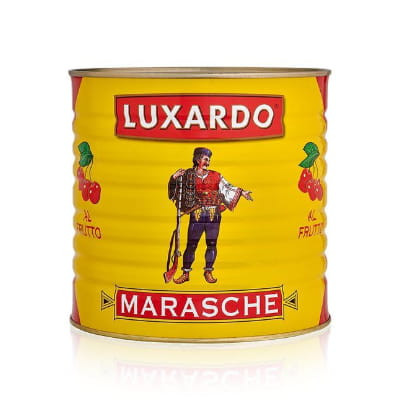
Kosher: KLBD (London Beth Din) for the cherries |
| Master Martini |
2 |
2 |
|
Sources: producers' websites and catalogues, November 2026. Certification applies to the individual product: always check the product page before buying.
Some examples with both certifications:
- Bases: Rubicone Lemon 50, MEC3 Salted Butter Caramel, Martini Orasì Oat Biscuit
- Pastes: Rubicone Hazelnut 5 Stelle, Rubicone Pistachio Natur C, PreGel Pistachio Elite, Rubicone White Chocolate Supreme, Martini Strawberry W., MEC3 French Vanilla
- Cremini and ripple sauces: Rubicone Cremino Banana Crunchy, PreGel Arabeschi Caramel Fleur de Sel, Martini Brunella Crok Bora Bora
- Soft serve and frozen yogurt: Rubicone Dragon Fruit Purple, MEC3 Soft-Ice Yogo, PreGel Frozen Yoggi
- Coatings and toppings: Rubicone Hazelnut Stick Coating, Rubicone Glitter Mixed Berry Topping
FAQ
Is gelato naturally halal?
Gelato made with milk, cream, sugar and fruit generally contains no forbidden ingredients, but the risk lies in added ingredients: flavourings in alcohol, liqueurs, gelatines or stabilisers of animal origin. To be sure you need certified ingredients.
Is a vegan product automatically Halal or Kosher?
No. Vegan rules out animal ingredients, but it may contain alcohol, and Kosher certification always requires checks by a rabbinical agency.
Can I write "Halal gelato" or "Kosher gelato" in my display case?
Only if the gelato shop is certified by a recognised body. Otherwise you can state that the flavour is made with certified ingredients, keeping the manufacturers' certificates.
Where can I find a product's certificate?
On the Gelq.it product page, if the manufacturer declares it, or in the technical data sheet. You can ask our customer service for the full certificate.
Read also








































 What to sell in a gelato shop in winter: 8 ideas to stay busy all yearLeggi tutto ...
 Toppings for gelato, bars and pastry: types, flavours, lines and how to use themLeggi tutto ...
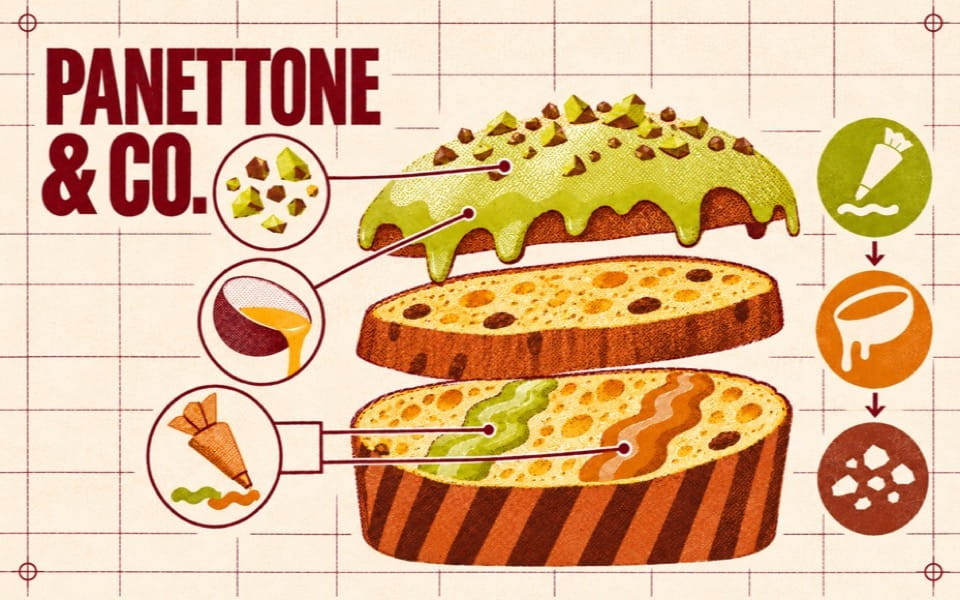 How to fill and glaze artisan panettone: 16 pairings for panettone and colombaLeggi tutto ...
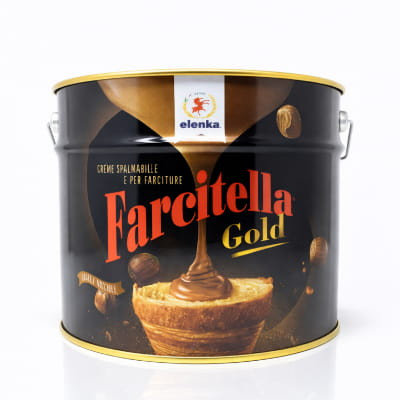
 Filling creams for croissants, tarts and cakes, our selectionFilling creams for croissants, brioche, tarts and cakes compared: Cremosette, Farcitella, Squeezita, Fruit Crmy,...Read more ...
 Gelato pastes: types, dosages and how to choose themHow much paste per kg of mix? The 8 types of gelato pastes, average dosages from over 700 technical sheets and how to...Read more ...
 Takeaway gelato containers: materials, sizes and how to choose themHow to choose takeaway gelato containers: materials (EPS, thermoformed polystyrene, paperboard), sizes and weights,...Read more ...